
Tips for New Landscape Photographers (Landscape Photography Tips)


We've all been there. You're standing in front of a breathtaking scene. You press the shutter button and then you look at the photo and it's just wrong. Well, today, let's fix that.
If you would rather watch this "Tips for new Landscape Photographers (Landscape Photography Tips)" in video form - click here
So, whether you have a professional camera or just your phone, these five tips will help you stop taking snapshots and start creating art. Let's dive in.
Tip number one, you want to master the best time to shoot. And usually this is golden hour. It's going to be the hour before sunset and the hour after sunrise. That's going to give you the best overall lighting on your scene where the light's soft, shadows are long, everything looks gorgeous. That's the main time you really want to aim to shoot.

You usually want to avoid shooting around noon in the middle of the day. That's when the light's really high and the shadows are really harsh and it creates real contrasty scenes that are real hard to manage. And even if you can manage them, they don't look that great. There's always an exception to the rule. works great for black and white or high contrast photos where you're going for that look. So don't always rule it out.
These rules are meant to be broken.
My personal favorite time to shoot is during blue hour and that's about 45 minutes before sunrise, 45 minutes after sunset and that's when the light is beyond the horizon and it's creating that soft ethereal glow and you can really create some different looks with long shutter speeds and transform scenes into unique art. So I personally like blue hour over golden hour but golden hour is the king still.

And a bonus tip, use weather apps to predict epic conditions like high cloud for colorful sunrises and sunsets, fog and mist for atmospheric conditions, for storm light, lightning, and more. Being in these conditions is really what elevates your photography.
Some of my favorite APPS to use for landscape photography are ClearOutside, YR, PhotoPills, MyRadar, Tides Near Me, OnX Hunt, AllTrails, Park4Night and more.
Alright, tip number two.
Use layers to create depth in your image. So don't just look at the horizon, think in layers. your foreground, your mid ground, your background, and how you can use those to tell a story and create depth.
An example of how you would use this is find a foreground subject like a rock, a flower, interesting textures, water, anything you can use up close to create interest in the bottom of your frame. Another technique is to get low and that'll emphasize your foreground subjects and shrink your mid ground and allow you to play with how much of the mid ground you include in the scene. Try to use leading lines to draw your viewer through the frame. Fallen trees, sticks, paths, water lines, all kinds of different things. Even negative space can be used.

Use anchors that hold your image down, like the bottom of the frame or the sides of the frame. Then use leading lines and shapes and different compositional techniques to really create a compelling image.
Tip number three.
We're going to go over some camera settings to get the most detail out of your shots. First of all, you want to set your camera to manual so that you have full control of the camera settings. For your ISO, you always want to shoot at the base ISO of the camera. That's usually 100 or 50. That's going to ensure you have the cleanest image with the least amount of noise and grain.
You always want to be shooting in RAW. This might be painful if you're not used to editing or you don't have an editing software picked out or you've never used one yet, but you always want to be shooting in RAW. That's how you get the most out of your camera, the most out of your camera's sensor, and the most out of your images. You're going to get the most dynamic range, the most detail, and if you want, you can shoot RAW and JPEG at the same time. That's no problem.
But always capture your raw images because you never know what gems you might find 5 years down the road.
For your aperture, use a high f-stop number like f8 through f-16. And that's going to allow you to capture the most in focus range in your image and give you the largest depth of field, which is the range of acceptable sharpness.
One more thing, you always want to protect your highlights. Modern cameras can really pull detail out of shadows, but you cannot recover blown highlights. So, if anything, always protect your highlights and make sure you have detail in your bright spots.
Next up, tip number four.
You got to have some decent stability. That's where the tripod comes in handy. You don't have to have anything crazy. I know they get insanely expensive, but this one I use was about a hundred bucks. I think $125 maybe at the most. It's decent. It's carbon fiber. It gets the job done. You might get annoyed with it like I do, but it does the job for most scenarios. Unless you're in some arctic wind or crazy surf, you'll be okay.

A sturdy tripod is essential for low light and long exposure photography. It allows for slower shutter speeds to get that smooth, silky water, beautiful water cascade textures, blurred clouds, and everything in between. A few things you might want to consider are weight, price, and functionality. Is it easy to hike with? How low can it shoot? These are some of the questions you might want to ask yourself about your specific shooting style.
Another thing to consider is using a remote shutter. Most cameras have a 2, 5, or 10 second timer in there. You're going to want to use that whenever you can. Sometimes when you're trying to time things, a remote shutter button is a lot easier, but most of the times you'll be just fine with the delayed timer in your camera. If you're shooting wide or regular focal length, the two-c timer should be more than enough. But if you're shooting at a telephoto length, you always want to go to the 10-second timer to make sure you allow everything to settle down before that shutter releases.
Tip number five.
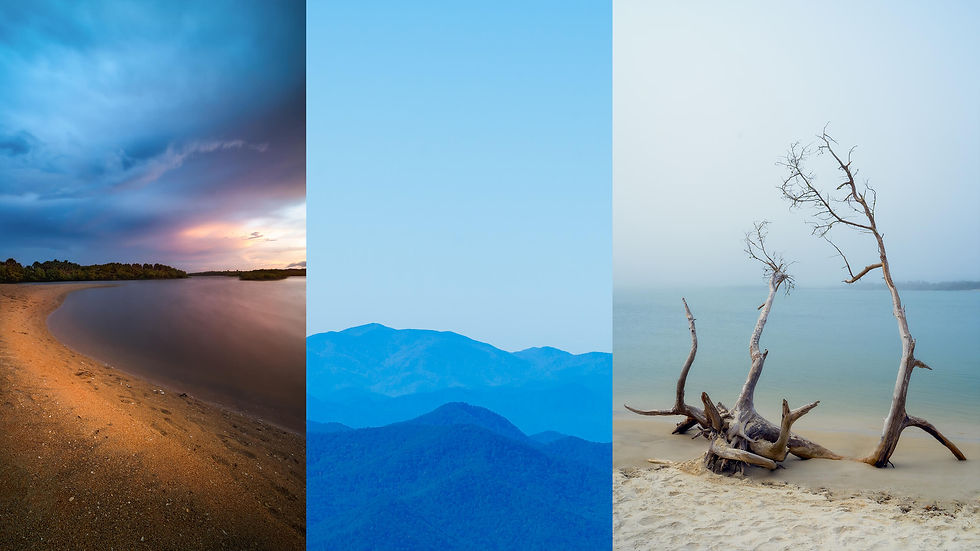
You want to simplify and scout. Photography is the art of omission. So, anything you can leave out that doesn't add to your story, it's going to benefit your composition.
And don't just go out there and hope for the best. Always pre-plan.
Research your locations beforehand using tools like Google Earth and satellite images. Find areas of interest. And if you want to know more information about how I scout local areas, you can check out my video on the topic right here.

Landscape photography is 80% about being at the right place at the right time. Be patient, show up early, and don't be afraid to fail. And before you know it, you're going to come away with some amazing images.
So, what's one landscape photography location on your bucket list? Drop it in the comments below. I'd love to know and check it out!
Florida Landscape Photography VLOG. Check out my THIS IS FLORIDA! series on YouTube where I am exploring the full length of Florida's A1A in search of the best landscape photography spots. Click here to Subscribe and follow along!
This Is Florida! Watch The Series Here!
---------------------------------------
Some links on this page are affiliate links and I may earn a small commission if you use any. An easy way to support me for free! Thank you!
---------------------------------------
My Stuff
100+ Ideas for Landscape Photographers Book:https://amzn.to/4cinISm
How to Extreme Focus Stack Ebook: https://amzn.to/48wEgon
North East Florida Guide: https://www.paulfaracephotography.com/florida-photo-guide
Marineland Seascape Workshop: https://www.paulfaracephotography.com/marineland
My Gear
My cameras: https://amzn.to/4vgrOTL
My wide angle lens: https://amzn.to/3QfoRTf
My mid range lens: https://amzn.to/4sV4U2y
My telephoto lens: https://amzn.to/48bU687
My drone: https://amzn.to/3PVgdt7
My action cam: https://amzn.to/4t2Knck
My microphones: https://amzn.to/4dE4n0a
My ND filter: https://amzn.to/4c2cLWe
My circular polarizer: https://amzn.to/41XllQ0


Comments