
Long Exposure Ocean Photography Tips: The Ultimate Seascape Guide


Do you want. to take those awesome seascape photos with silky or misty water? Learn all the tips and tricks to get the most out of your long exposure ocean photography images and take your skills to the next level. I will cover seascape long exposure camera settings, the best ND filters for ocean photography and more.
Be sure to check. out the image gallery at the end, let's dive in!
All images and words by Paul Farace Photography
Paul Farace is an award winning Florida based landscape photographer and author with 20 years of experience, specializing in capturing the state's coastlines and waterways. Operating out of St. Augustine, he shares his expertise through fine art prints, adventure videos, educational workshops, and digital content. Explore his work and bio details at Paul Farace Photography.
Some links on this page are affiliate links and I may earn a small commission if you use any. An easy way to support my efforts for free. Thank you!
Long Exposure Ocean Photography Tips
Essential Gear for Coastal Long Exposures
Choosing the right gear is crucial for capturing dynamic stunning seascapes, but what is essential and what can you leave behind?

Ocean photography tripods, keep it steady and lock in
A tripod is essential to hold you camera steady during long exposures. You don't have to have the most expensive one, but something that will keep your camera still in sand, wind and surf. And it needs to be carbon fiber to reduce corrosion from salt water. Here are a few options to check out from $80-200 that would work great if you're getting started.
Neewer Carbon Fiber Tripod - 64" (I use this, my backup & video tripod)

Choosing the right ND Filter (6-stop vs 10-stop)
Long exposure seascapes almost always require you have a neutral density filter. As soon as the sun comes up you will need to use them to keep your shutter speeds in range.
Do you get a 3, 6 or 10 stop filter? A whole kit?
I used a single filter for years and if there is one filter strength that is the best for seascapes it would be the 6-stop. A 10-stop is great to use, but for silky texterued water cascades you want to stay within 1/8 to a few seconds and a 6-stop usually works best in these conditions.
This is the 6-Stop filter I have used for years. Love it, amazing image quality but it is not cheap.
I recently tested the K&F Nano-X Series 10 Stop and they performed very well. Especially for the price. It also is a full magnetic system which is MUCH easier to use over tradtional screw on only filters. They offer the Nano-X filter in all standard strengths and a full kit.
I'm now a K&F affiliate, so if you the link below with my code "FARACE" you can grab 20% off.
Check it out here: K&F Concept Magnetic 10 Stop Filter Kit
Something to consider is focusing while using ND filters. Often you will have to focus and then put your filter on because the light is too low to focus with the filter on. This is where the magnetic filter systems really help workflow and ease of use.
Article: 5 Best ND Filters for Beginners Landscape Photography (All Budgets)
The Best Camera Settings for Seascape Motion Blur
With your sturdy tripod and trusty ND filter you are ready to dial in the exact look you want to achieve stunning seascapes.
Shutter speed rules (misty water vs dynamic wave textures)
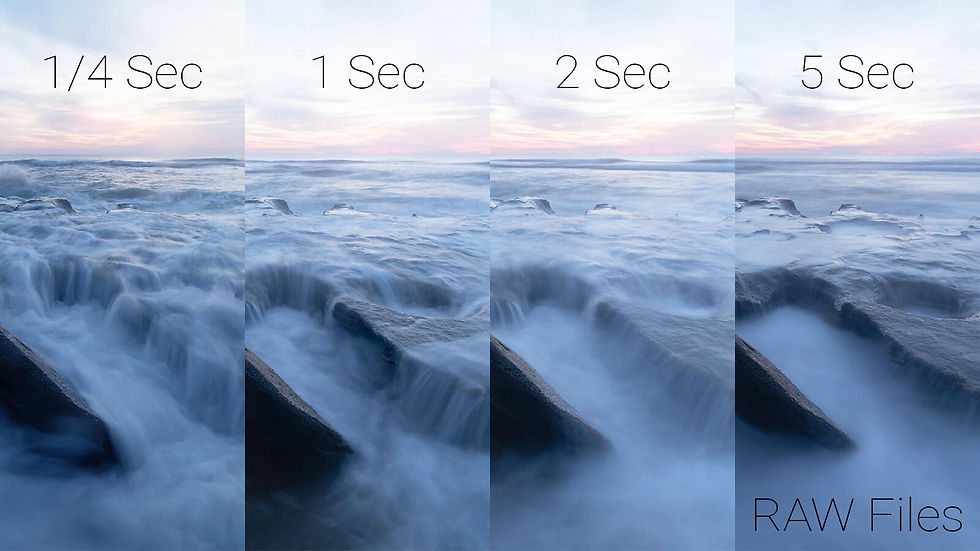
To get those classic silky cascades you need to dial in around 1/4 seconds to 2 second range.
To capture misty ethereal images you need to extend your shutter to 2 seconds and beyond. And anything after around 5 seconds will really begin to take out nearly all the texture in the water.
Anything in 15-30 second range will completely eliminate water textures and multi-minute exposures create an entirely otherworldly look.

The ISO and aperture setting sweet spot
When the light is low and you are going for a desired look, you will have to compromise on aperture and ISO.
ISO
Luckily today's noise reduction is absolutely amazing in editing software. i have no issues shooting up to ISO 800 or more for low light shots.
Aperture
Use a narrow aperture to get as much as your scene in focus as possible while still allowing in enough light. For full frame try not to go over f16, for a crop sensor even less (f8-f11). You may have to start with a wide aperture, f2.8-f5.6 range, if the light is very low still or extend the shutter for very long exposures.
How to capture moving water in seascape photography
Alright you are all setup, gear, settings, now how do you capture these cascades or misty images?
First find and setup your composition, and then push your tripod down into the sand with some force unless you are situated on rocks or a hard surface. Any tiny shake or movement will be cause a blurry image. This will ensure your tripod is locked in and steady.
Timing is everything when it comes to this kind of photography, but you can't just press your shutter for long exposures. You need a way to trigger your shutter without touching the camera. That could be the built in timer, an app on more modern cameras or an extrenal shutter release.
I mainly use my camera's built in timer at 2 seconds for wide angle shots. It's a bit tougher to time, but my Sony A7iii is not compatible with their app and I don't like exposing my side panel to connect a release cable in water environments. It can be a little tough to time the waves with the timer, but you get used to it after some time.
Be sure to experiment with the waves coming in as well as the waves receding back out. When the waves crash in you can capture amazing cascades, but when it draws back out it creates silky leading lines that draw your viewer through the frame. I always have a hard time deciding which shot to use between the two styles.

Protect your camera from sand and salt spray
When you are photographing the ocean from such a close distance it's almost inevitable that you will have some risks involved. I'm not lying when I say I have put 4 cameras into the Atlantic, but I do push it way to far and get way too focused at times! Be careful out there and protect yourself and your gear.
Use a weather sealed camera and lens whenever possible.
Know your tides. Is it incoming? Outgoing? How many hours until peak? Is it a king tide? Many factors come into play with the ocean, so do your research and preparation.
This may be one of the only times I would suggest considering a UV filter to protect your glass. I once tipped my tripod forward, free fall into rocks, and my (expensive ND) filter took the hit, busted into pieces, but saved my lens. And then into the sea water...That was the first day testing a brand new lens...things happen. Be careful.
Wash your tripod in fresh water as soon as you return. Or else suffer the fate or full corrosion on any piece that isn't carbon fiber!
Wipe down your gear, camera, lenses and everything else with a slightly moist micro fiber cloth. Use a lens pen on lens and filter glass, a must have.

Capturing the perfect coastal long exposure requires patience, timing, and a willingness to get your boots a little wet. Grab your ND filter, head out before the next golden hour, and let the rhythm of the tide guide your lens.
If you are new to landscape photography you can grab my Free Landscape Photography Basics Ebook by signing up for my newsletter right here, now get out there and make some art!
Long Exposure Seascape Image Gallery
Blue Hour Cascades Minimal long exposure Pastel Cascades in Ocean Fog Vintage 50MM Lens long exposure St Johns River Dock Pilings Canon T2i Camera challenge 169 Second Exposure Black Rock Beach Sunrise Abandoned Sailboat in Flagler
Here are some more articles to check out next:
And
Here are some videos to check out:
Thanks for reading!
Check out my portfolio right here! Paul Farace Photography.
My Stuff
My Website: https://www.paulfaracephotography.com/
100+ Ideas for Landscape Photographers Book: https://amzn.to/4cinISm
How to Extreme Focus Stack Ebook: https://amzn.to/48wEgon
North East Florida Guide: https://www.paulfaracephotography.com/florida-photo-guide
Marineland Seascape 1on1 Guide: https://www.paulfaracephotography.com/marineland
My Gear
My cameras: https://amzn.to/4vgrOTL
My wide angle lens: https://amzn.to/3QfoRTf
My mid range lens: https://amzn.to/4sV4U2y
My telephoto lens: https://amzn.to/48bU687
My drone: https://amzn.to/3PVgdt7
My action cam: https://amzn.to/4t2Knck
My microphones: https://amzn.to/4dE4n0a
My ND filter: https://amzn.to/4c2cLWe
My circular polarizer: https://amzn.to/41XllQ0


Comments